



By REX CLEMENTINE in Galle
With runs drying up like a parched wicket under the blazing sun, the writing had been on the wall for Dimuth Karunaratne. Before the selectors could raise the finger, he walked, announcing his retirement – a decision so typical of a man known for his pragmatism. Once again, he put the team ahead of himself, just as he always had.
It was the kind of selflessness you’d expect from someone who, two years ago, voiced his dismay when the selectors failed to name a successor at the end of the Test Championship cycle. He believed that a new skipper should take the reins when the next cycle began, setting fresh goals and charting a bold course. Such integrity is a rare commodity in modern cricket. In fact in any walk of life. Dimuth wasn’t power hungry. He always saw the larger picture. Ranil has so much to learn from Dimuth.
Dimuth’s career, spanning 15 years, was largely blemish-free – a remarkable feat in an era where cricketers live under the unrelenting glare of public scrutiny. The only blot on his copybook was a road accident that saw him charged with drunk driving.
But unlike some of his peers, he didn’t attempt a cover-up. He faced the music, compensated the affected party, accepted Sri Lanka Cricket’s heavy fine, admitted his fault, and moved on. It was the kind of accountability that set him apart.
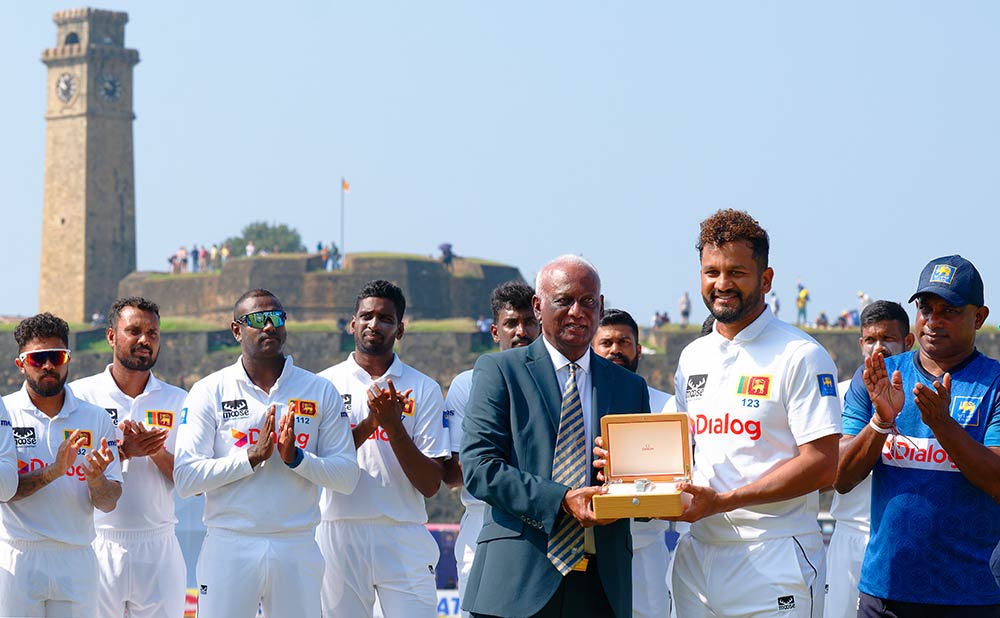
Beyond that, his discipline was second to none. Never late for a training session. Never embroiled in a feud – be it with teammates, coaches, selectors, or even reporters. He played the game the right way, walking away with the respect of both his own dressing room and his adversaries. The Aussies, a side that does not hand out compliments easily, gave him a rousing guard of honour in his farewell Test – a fitting tribute.
These Karunaratnes, they are a fine lot. His father, Lal, worked at the Road Passenger Transport Authority, while his mother, Chandrika, was a devoted homemaker. His younger sister, Dilki, settled in Australia a few years ago. From their early days in Maradana, the family moved to the more affluent suburb of Pelawatta. But no matter how far Dimuth’s cricketing journey took him, he remained rooted in family values. The sight of his mother holding onto his hand during the presentation in Galle before his 100th Test was a moment that tugged at the heartstrings.
Dimuth, the man, will be celebrated even more than Dimuth, the cricketer – and that is a rare thing to say about a modern-day subcontinental player.
He was Sri Lanka’s crisis man, the go-to leader when chaos reigned. He took charge when deep divisions had fractured the team – the selectors keen on asserting their authority, the team management desperate to stick to their blueprint. Dimuth was the bridge between the two warring camps, and his ability to unite them bore fruit in the form of unprecedented success.
His crowning glory as captain came in 2019 when he led Sri Lanka to a historic Test series victory in South Africa. No other Asian team – not even Pakistan with their arsenal of fast bowlers, nor India with their batting juggernauts – had conquered the Proteas in their own backyard. That triumph remains one of Sri Lanka’s greatest feats.
Dimuth’s leadership style was unique, understated yet effective. When you speak of great captains, you think of Imran Khan’s charisma, Mike Brearley’s tactical genius, Arjuna Ranatunga’s defiance, or Ian Chappell’s steely resolve. Dimuth possessed none of those traits in abundance, yet he skippered with quiet authority, proving that leadership comes in many forms.
In the lead-up to the 2019 World Cup, Sri Lanka’s team was so divided that the selectors, desperate for unity, thrust Dimuth into the ODI squad – despite the fact that he hadn’t played a 50-over game for over four years. Such was the faith in his ability to bring order to the chaos.
As an opening batsman, he was a purist’s delight – disciplined, resolute, and blessed with the ability to bat long. He was a throwback to an era when opening the innings was an act of endurance, not just aggression. But it must be said – he underachieved with the bat. With his technique and temperament, he should have averaged comfortably over 40. Yet, as Father Time tightened its grip, the big scores began to elude him. Cricket, after all, is a game where even the best eventually get beaten.
Still, what a career it has been. Dimuth Karunaratne – the selfless leader, the crisis man, the gentleman cricketer. A man who cared deeply for his parents, his mates, and his beloved SSC. A man who, in both life and cricket, stayed true to his middle name – Frank.